Ditapis dengan
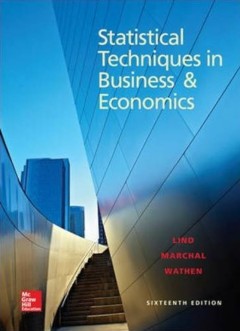
Statistical techniques in business and economics
- Edisi
- 16th ed.
- ISBN/ISSN
- 978-1-259-09564-1
- Deskripsi Fisik
- xxx, 830 p. : figs., tabs., index. ; 25 cm.
- Judul Seri
- -
- No. Panggil
- UA/AA Lin
- Edisi
- 16th ed.
- ISBN/ISSN
- 978-1-259-09564-1
- Deskripsi Fisik
- xxx, 830 p. : figs., tabs., index. ; 25 cm.
- Judul Seri
- -
- No. Panggil
- UA/AA Lin
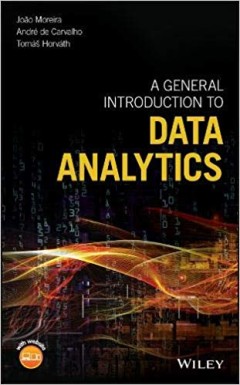
A General introduction to data analytics
A guide to the principles and methods of data analysis that does not require knowledge of statistics or programming A General Introduction to Data Analytics is an essential guide to understand and use data analytics. This book is written using easy-to-understand terms and does not require familiarity with statistics or programming. The authors—noted experts in the field—highlight an expl…
- Edisi
- -
- ISBN/ISSN
- 9781119296249
- Deskripsi Fisik
- xix, 323 p. : figs., tabs., index. ; 24 cm.
- Judul Seri
- -
- No. Panggil
- UEBB Mor

Systems thinking : managing chaos and complexity : a platform for designing …
It's a holistic approach to systems methodology. It deals with all dimensions of a system: structure, function and process. Peter Senge introduced Systems Thinking/practice. Interact clients asked the author to write a book to take them "further down the Senge trail". This book does that by taking the reader into "real world" stories. It is based on experiences in five real companies using syst…
- Edisi
- -
- ISBN/ISSN
- 978-0123859150
- Deskripsi Fisik
- ix, 351 p. : ill., tabs., index. ; 23 cm.
- Judul Seri
- -
- No. Panggil
- LXMF 79 Gha

Introduction to meta-analysis
Meta-analysis has become a critically important tool in fields as diverse as medicine, pharmacology, epidemiology, education, psychology, business, and ecology. Introduction to Meta-Analysis: Outlines the role of meta-analysis in the research process Shows how to compute effects sizes and treatment effects Explains the fixed-effect and random-effects models for synthesizing dat…
- Edisi
- -
- ISBN/ISSN
- 978-0470057247
- Deskripsi Fisik
- xxix, 418p. : ill., index. ; 25 cm.
- Judul Seri
- -
- No. Panggil
- LQ 41 Int

Compensation
Table of Contents : Chapter 1. The Pay Model Chapter 2. Strategic Perspectives Part 1 Internal Alignment: Determining the Structure Chapter 3. Defining Internal Alignment Chapter 4. Job Analysis Chapter 5. Evaluating Work: Job Evaluation Chapter 6. Person-Based Structures Part 2 External Competitiveness: Determining the Pay Level Chapter 7. Defining Competitiveness Chapter 8…
- Edisi
- 9th Ed.
- ISBN/ISSN
- 978-0071259323
- Deskripsi Fisik
- xvii, 652p.: exhibits, index ; 24 cm.
- Judul Seri
- -
- No. Panggil
- FF 79 Mil

Job analysis : methods, research, and applications for human resource managem…
Brannick and Levine provide students and professionals in management and I/O psychology with the methods and applications of job analysis. Job analysis covers a host of activities, all directed toward discovering, understanding, and describing what people do at work. It thus forms the basis for the solution of virtually every human resource problem. The authors describe several job analysis met…
- Edisi
- -
- ISBN/ISSN
- 0-8039-7203-2
- Deskripsi Fisik
- xiii, 353 p. : tabs., gloss., refs., 23 cm.
- Judul Seri
- -
- No. Panggil
- FBB Bra

Financial statement analysis
Tabel of Contents : 1. Overview of Financial Statement Analysis 2. Financial Reporting and Analysis 3. Analyzing Financing Activities 4. Analyzing Investing Activities 5. Analyzing Investing Activities : Intercorporate Investments 6. Analyzing Operating Activities 7. Cash Flow Analysis 8. Return on Invested Capital and Profitability Analysis 9. Prospective Analysis 10. Credit Analys…
- Edisi
- 9th Ed.
- ISBN/ISSN
- 978-0071251410
- Deskripsi Fisik
- xxii, 657 p.: apps., exhibits, index ; 26 cm.
- Judul Seri
- -
- No. Panggil
- ELCB 310 Wil

Equity valuation and portfolio management
Equity valuation is a method of valuing stock prices using fundamental analysis to determine the worth of the business and discover investment opportunities. In Equity Valuation and Portfolio Management Frank J. Fabozzi and Harry M. Markowitz explain the process of equity valuation, provide the necessary mathematical background, and discuss classic and new portfolio strategies for investment…
- Edisi
- -
- ISBN/ISSN
- 978-0-470-92991-9
- Deskripsi Fisik
- xxv, 550 p. : ill., tabs., index. ; 23 cm.
- Judul Seri
- -
- No. Panggil
- ELAV/EF Equ

Mastering value at risk
Value at Risk (VAR) is rapidly emerging as the dominant methodology for estimating precisely how much money is at risk each day in the financial markets. This book provides an objective view of VAR, analyzing its pitfalls and benefits. (text from the publisher)
- Edisi
- Market edition
- ISBN/ISSN
- 0-273-63752-5
- Deskripsi Fisik
- xiii, 241 p. : tabs., figs., refs., bibs., gloss.,
- Judul Seri
- -
- No. Panggil
- ELAV/EEQ But

Principles of corporate finance
"Principles of Corporate Finance" is the worldwide leading text that describes the theory and practice of corporate finance. Throughout the book, the authors show how managers use financial theory to solve practical problems and as a way to respond to change by showing not just how, but why companies and management act as they do. This text is a valued reference for thousands of pract…
- Edisi
- 11th ed.
- ISBN/ISSN
- 978-0-0771-5156-0
- Deskripsi Fisik
- xxvi, 1093 p. : tabs., figs., index ; 26 cm.
- Judul Seri
- -
- No. Panggil
- EE Bre
 Manajemen Keuangan
 Human Resource Management
 Marketing Management
 Operations Management
 Strategic Management